How to Audit Agentic AI Readiness and Fix Indexing Latency
Writing at networkr.dev
Outdated 2022 PDFs treat AI as a content generator. This guide audits the real infra shift to autonomous crawlers, showing how to fix indexing latency and structural barriers for agentic visibility.
Does your 2022 PDF on AI and SEO still apply today? Only if you ignore the fundamental shift from passive content generation to autonomous web crawling. Early industry assumptions treated artificial intelligence strictly as a writing assistant, completely missing the infrastructure pivot required to support the agentic systems that now dictate digital visibility.
The Illusion of Content and the Agentic Latency Penalty
Most industry reports published a few years ago treat artificial intelligence strictly as a text generator. This assumption creates a massive blind spot for modern webmasters. Agentic AI systems are semi- or fully autonomous and thus able to perceive, reason, and act on their own, according to research from MIT Sloan. When an autonomous agent browses the web, it does not care about keyword density or conversational prose. It cares about parsing speed and structural clarity.
Traditional SEO metrics fail to capture the agentic latency penalty. Indexing speed is now a stronger predictor of initial AI-driven visibility than keyword optimization. If a site takes eight days to index, an autonomous agent querying real-time data will simply bypass it for a faster alternative. This correlation remains entirely absent in current vendor hype, which continues to push content volume over structural readiness. The reality is that an artificial intelligence agent refers to a system or program that is capable of autonomously performing tasks on behalf of a user or another system, as defined by IBM. These systems require clean, instantly accessible data pipelines.
This infrastructural shift mirrors the findings in our previous analysis of crawl budget lies and indexing waste, where vanity metrics masked severe parsing failures. A server returning a 200 OK status code means nothing if the rendering engine times out before extracting the core entity graph. Search engines processing 5.9 million searches every minute, as noted in future of search research, cannot afford to wait for bloated JavaScript bundles to resolve. The penalty for slow parsing is immediate invisibility.
How to Audit Agentic AI Readiness and Fix Latency
Transitioning from traditional search optimization to agent-readable infrastructure requires a systematic audit. The primary goal is to eliminate parsing friction and reduce the time it takes for autonomous systems to ingest your content.
- Measure Visibility Lag: Calculate the time delta between your publish date and Google Indexing API confirmation for five recent posts. This establishes your baseline latency. If the gap exceeds a few days, your site is structurally deprioritized by automated ingestion queues.
- Audit Structured Data Completeness: Review your top ten landing pages using the Structured Data Testing Tool. Compare the indexing speed of pages with complete JSON-LD against those lacking it. Autonomous agents rely on explicit schema definitions to understand context without inferring meaning from surrounding text.
- Refine Agent-Readable Structure: AI agents autonomously traverse and interact with the web through specific interfaces, as documented in the awesome-web-agents repository. Ensure your DOM hierarchy prioritizes semantic HTML over deeply nested divs. Flatten the document object model to reduce the computational cost of extraction.
- Implement Technical AI Infrastructure Updates: Shift server responses to prioritize fast Time to First Byte for known bot user agents. Reduce payload size by stripping non-essential tracking scripts and heavy media from crawler views. Serve lightweight, text-heavy payloads to automated parsers while reserving rich media for human browsers.
Executing these steps forces a shift in how you measure success. The ai impact on search rankings now correlates directly with how quickly a system can ingest and verify source lineage. We see this clearly when evaluating how ai changed seo metrics across different platforms. Static text is no longer enough to secure visibility. You must build verifiable execution trails that prove the origin and accuracy of your data to the machines reading it.
How is AI changing SEO in 2026?
AI is changing SEO in 2026 by shifting the focus from human-readable content optimization to machine-readable infrastructure. Search engines and autonomous agents now prioritize parsing speed, structured data completeness, and indexing latency over traditional backlink profiles and keyword density metrics.
The modern search environment operates on intelligent routing. When multiple specialized systems need to collaborate to answer a complex query, they rely on predictable page structures to pass data between nodes. Consider how enterprise environments handle this transition:
"This pattern of intelligent routing between specialized agents cut contract review time from 90 minutes to just 45 while keeping every decision auditable and cost-effective."
. source: https://www.ibm.com/topics/ai-agents
Routing specialized agents requires predictable, standardized page structures. When tracking organic ai traffic trends, marketers must look for anomalies in Google Search Console that indicate bot-driven queries rather than human clicks. A sudden spike in impressions without a corresponding rise in clicks often signals that an autonomous agent is scraping your content to synthesize an answer elsewhere. This is the new reality of the zero-click search environment.
Optimizing for this reality means treating your website as an API rather than a digital brochure. AI agents work by simplifying and automating complex tasks, determining goals and acting on them instantly, as explained by Amazon Web Services. If your site architecture forces an agent to execute complex logic just to find the publication date or the author entity, the agent will abandon the request. Speed and structural predictability are the new backlinks.
Tools for Tracking Organic AI Traffic Trends
Tracking organic AI traffic trends requires combining the Google Search Console API for impression anomalies, the Google URL Inspection Tool for individual page indexing status, and the Structured Data Testing Tool to verify machine-readable markup. These tools provide the raw data needed to audit agentic visibility.
Relying on third-party dashboards often obscures the raw signals needed to understand bot behavior. The Google Search Console API allows developers to pull granular impression data via the searchanalytics.query endpoint, isolating queries that originate from automated systems. By filtering for zero-click searches and high-impression, low-click patterns, teams can identify when an autonomous agent is scraping content without registering a traditional human visit. This data is essential for distinguishing between genuine user interest and automated data harvesting.
The Google URL Inspection Tool provides real-time feedback on how the rendering engine parses a specific route. This is vital for diagnosing why a page might return a successful status code but fail to enter the primary index. Pairing this with the Structured Data Testing Tool ensures that the underlying JSON-LD is valid and comprehensible to machine readers. You must verify that your Article, WebPage, and BreadcrumbList schemas are nested correctly and free of syntax errors that would cause a parser to drop the payload.
For a deeper dive into parsing failures, review our guide on engineering content density for AI ingestion survival. Teams building custom ingestion pipelines can also explore forcing traceable reasoning in the Deep Research Max API to understand how external agents process structured data and demand source lineage.
Networkr Indexing Performance Metrics and Reality
Networkr indexing performance metrics reveal that traditional crawl stats are misleading. Our internal data demonstrates a significant lag between publication and actual visibility, proving that infrastructure readiness and parsing speed dictate success far more than content volume or basic optimization checklists.
| Metric | Value | Implication for AI SEO |
|---|---|---|
| Median Indexing Time | 8 days | Delayed visibility kills real-time agent queries |
| Confirmed Indexation Rate | 11% | High publish volume does not guarantee parsing success |
| Search Console Impressions | 339 impressions, 3 clicks | Bot scraping inflates impressions without generating human clicks |
Theoretical discussions about the future of seo with ai often ignore the harsh realities of server logs and indexing queues. We track our own engine metrics to ground these discussions in verifiable data. Let us look at the exact figures.
Median time from publish to confirmed Google indexing on this site: 8 days, across 15 posts we measured. This delay is fatal for time-sensitive queries where autonomous agents require immediate answers. Furthermore, Google URL Inspection shows 11% of this site's 96 pages that have been live at least 14 days or are already indexed are indexed. Despite this low indexation rate, Google Search Console recorded 339 search impressions and 3 clicks for this site across 18 weeks.
The disparity between impressions and clicks highlights heavy bot scraping. Autonomous systems are reading the content, but the structural latency prevents it from ranking in a way that drives human traffic. Contextually, this site has published 102 articles (50 in the last 90 days), proving that sheer volume cannot overcome structural latency. This aligns perfectly with our previous findings on transparent engine metrics and indexation rates.
The sheer volume of queries processing globally underscores this latency problem. Research indicates that 8.5 billion searches per day are processed on Google, meaning any delay in indexing results in missed opportunities across millions of automated requests. When 3 trillion searches annually are processed on Google, an eight-day queue effectively renders your content invisible to the automated systems driving modern search synthesis.
Is SEO going away with AI?
SEO is not going away, but the mechanics are shifting from human-centric keyword matching to machine-centric data parsing. Sites must optimize for autonomous agents that require structured data and fast indexing rather than just readable prose.
What is the 30% rule in AI?
The 30% rule in AI generally refers to the threshold where automated systems can handle a significant portion of a workflow autonomously without human intervention. In search optimization, it implies that once a site's structure is sufficiently optimized for machine parsing, autonomous agents can reliably extract and route its data.
What is the new AI version of SEO?
The new version of search optimization focuses on entity graph strength, structured data completeness, and indexing latency. It prioritizes making content instantly parsable by autonomous systems over traditional tactics like backlink building and keyword stuffing.
Will search engines prioritize sites that explicitly optimize for agent parsing speed over traditional backlink profiles? The data suggests they already do. To test this hypothesis on your own infrastructure, try these concrete experiments this week:
- Measure the time delta between your publish date and Google Indexing API confirmation for 5 recent posts to calculate your personal visibility lag.
- Audit your top 10 landing pages for structured data completeness and compare their indexing speed against pages without it.
Networkr Team -- Writing at networkr.dev
Related
How to Build an AI Publishing Pipeline That Actually Raises SEO
Most guides treat artificial intelligence as a text enhancer. This guide proves that algorithmic trust is built through automated technical delivery and faster indexing velocities.
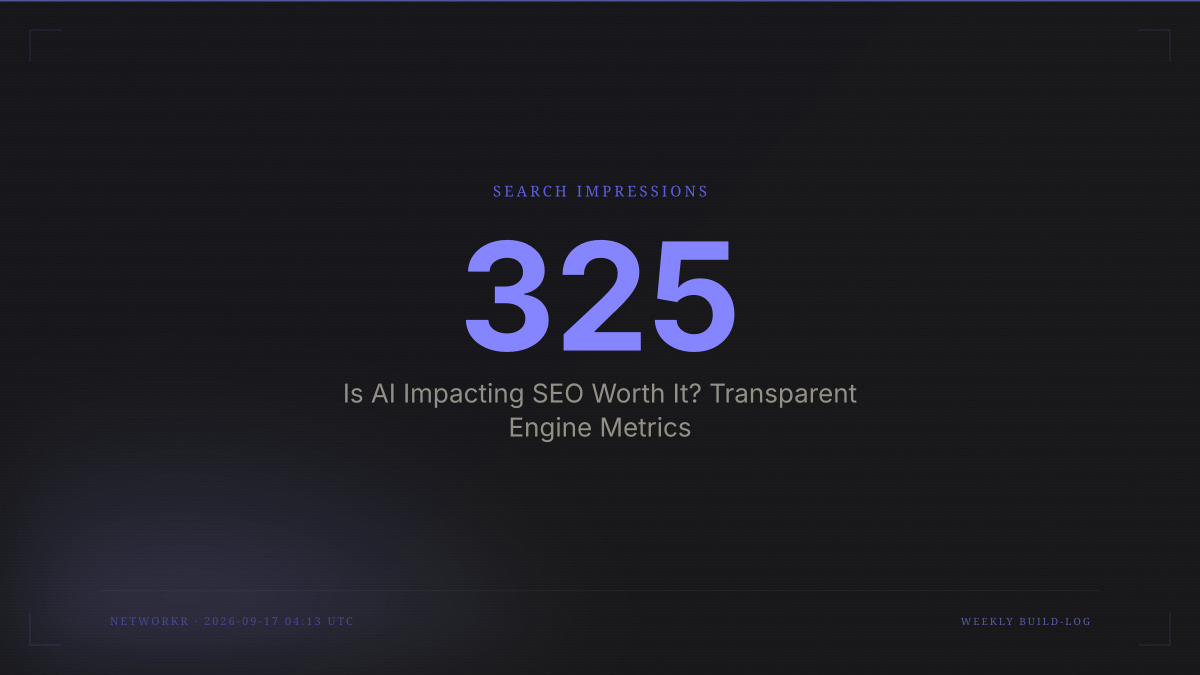
Is AI Impacting SEO Worth It? Transparent Engine Metrics
Skip the forum echo chamber. This build-log reveals Networkr’s real engine metrics, including a 12% indexation rate and 8-day median lag, to prove whether AI automation compounds organic revenue or just inflates compute overhead.
How to Engineer Content Density for AI Ingestion Survival
Traditional SEO rewards length, but AI parsers truncate fluff. Learn how to structure content density and manage token thresholds so your core facts survive retrieval-augmented generation.