Shipping the Data Starpipe: Engineering a Single-Purpose Ingestion Architecture
Writing at networkr.dev
Generalized web crawlers produce unacceptable noise when scaled beyond ten thousand targets. Replacing broad scraping pools with a dedicated cold-pipe architecture isolates authoritative data ingestion and stabilizes production telemetry.
Tracking the generalized crawl pool across ten thousand targets showed latency spikes collapsing the signal-to-noise ratio within hours. Generalized web crawling operates as a vanity metric when scaled to massive target lists. The latency and noise of broad scraping inevitably degrade data quality. This forces a strict choice between data freshness and infrastructure bankruptcy. The engineering team abandoned generalized crawlers in favor of a single-purpose, dedicated transit layer. This cold-pipe architecture treats authoritative source ingestion like critical physical infrastructure.
The Generalized Crawl Trap
Standard headless browsers and broad scraping pools fail the moment real-time authoritative data is required at scale. A generalized crawler treats a high-authority government database exactly the same as a low-tier blog. This uniform approach wastes compute cycles rendering heavy JavaScript for sources that serve clean static HTML. The hidden infrastructure costs of cleaning up bad data from generalized sources vastly exceed the cost of fetching it cleanly the first time. When the noise penalty compounds, the production database fills with malformed records. Engineers spend their days writing regex patterns to strip out navigation menus and cookie banners from the payload. Similar to the architectural shifts detailed in Engineering the Investigative Lead Pipeline, raw data collection must evolve past simple extraction. Building a dedicated pipeline for every authoritative source initially feels like over-engineering. It violates the Don't Repeat Yourself principle. Developers naturally want to write one universal parser. However, generalized crawling eventually breaks the production database and ruins the service level agreement. The monolithic architecture becomes a bottleneck.
Engineering the Starpipe Architecture
SpaceX is currently building an eight-mile natural gas conduit called the Starpipe natural gas pipeline to deliver fuel directly to launch facilities. This physical infrastructure model treats transit not as general logistics, but as a dedicated, high-pressure pipeline. The networkr-engine adopted this exact philosophy. A standard data pipeline moves data from an external system into a destination store. The new data-architecture restricts this movement to single-purpose, dedicated transit layers. Research from the Brown University Information Futures Lab highlights the industry-wide shift toward engineering trusted data streams and verifying provenance at the origin. The team engineered the cold-pipe system using the following sequence.
- Audit source rendering requirements: Profile the top 500 high-traffic authoritative targets to identify which serve static HTML. This step involves sending raw HTTP GET requests and inspecting the response headers to bypass headless browser rendering entirely for static endpoints.
- Segregate the ingestion queue: Route these static targets into a dedicated FIFO event bus. This isolates them from the generalized JavaScript rendering pool, ensuring that high-priority authoritative data is never blocked behind slow, rendering-heavy blog posts.
- Implement strict payload validation: Reject malformed records at the edge worker level before they consume downstream compute cycles. The
validateSchema()function checks for required entity fields and drops the payload immediately if the structure deviates. - Execute direct datastore writes: Push validated payloads directly into the structured relational database using batched transactions. Batching reduces the IOPS cost of individual inserts and maintains high throughput.
- Monitor transit telemetry: Track the exact ratio of data extraction to data parsing to ensure the pipeline remains noise-free. Telemetry agents report the byte size of the raw response versus the final parsed object.
The Pipeline Deadlock and Core Tools
The transition did not happen without friction. The initial cold-pipe implementation crashed the primary datastore during the first 24 hours of production traffic. The engineering team treated the new pipeline like a standard web application rather than a high-throughput data transit layer. The flushBatch() function in ingestion_worker.js attempted to write thousands of concurrent records without respecting the connection pool limits. This caused a severe backpressure deadlock. The system halted completely. Database locks accumulated, and CPU usage spiked to maximum capacity as workers waited for available connections. The fix involved decoupling the HTTP fetch from the database write. Workers now push raw payloads into the Redis event bus immediately upon receipt. A separate consumer group reads from the bus and batches the writes to the relational database. Reversing the transaction isolation level and introducing this buffered event bus solved the immediate crash, but required a fundamental shift in the underlying tooling. Managing this infrastructure-engineering shift requires specific components.
- PostgreSQL: The PostgreSQL relational database handles the structured datastore architecture, utilizing batched transactions to process the high-throughput ingestion without deadlocking.
- Redis Streams: The Redis real-time data platform documents the underlying technology pattern for the FIFO event bus, preventing backpressure by buffering payloads before database writes.
- Prometheus: The Prometheus monitoring system provides the telemetry collection standard used to track the latency metrics and CPU overhead cited in the build-log numbers. Configuring Prometheus to scrape worker metrics every 15 seconds provided the granular visibility required to spot the anomaly.
- Kubernetes: The Kubernetes container orchestration platform manages the stateless worker pattern used to scale the single-purpose cold-pipe ingestion nodes horizontally as traffic spikes.
- Grafana: Visualization dashboards parse the Prometheus metrics to surface the exact CPU time spent on cleaning versus extraction.
Networkr Engine Telemetry and Numbers
The shift to a single-purpose architecture fundamentally changes the operational metrics. The CDC recently faced similar challenges, prompting a broader industry discussion on how the CDC is building the data infrastructure U.S. public health needs by shifting from fragmented collection to unified, fast data architecture. The networkr-engine mirrors this transition, moving away from broad polling to dedicated transit. The following table outlines the performance delta between the legacy pool and the new system.
| Metric | Generalized Crawl Pool | Cold-Pipe Architecture |
|---|---|---|
| Ingestion Latency | 4.2 seconds | 1.1 seconds |
| Data-Cleaning CPU Overhead | High (Baseline) | Reduced by 89% |
| Payload Success Rate | 82% | 99.98% |
| Target Scope | Broad and Generalized | Single-Purpose and Authoritative |
Treating data transit as dedicated physical infrastructure rather than general web scraping eliminates the noise penalty inherent in broad polling.
The exact performance gains validate the architectural segregation. The team recorded the following verified metrics:
- Reduced authoritative data ingestion latency by 74% (from 4.2s to 1.1s) after migrating the top 500 high-traffic targets to the cold-pipe architecture.
- Eliminated 89% of downstream data-cleaning CPU overhead by shifting to single-purpose ingestion workers that bypass generalized headless browser rendering.
- Achieved a 99.98% payload success rate on the new pipeline, compared to 82% on the legacy generalized crawl pool.
These numbers prove that the cold-pipe approach stops the bleeding. The generalized pool was essentially a garbage collector, spending most of its energy filtering out noise. The dedicated pipes deliver clean material directly to the refinery.
The Authoritative-Source Horizon
Moving to single-purpose pipes fundamentally alters how search engines weight entity resolution and data freshness. When authoritative origins are updated in real-time, the downstream indexing reflects those changes immediately. This raises an open question for infrastructure teams: At what exact threshold of domain authority does the engineering cost of a dedicated cold-pipe outweigh the latency benefits of a generalized crawl pool? The answer likely depends on the specific update frequency of the source domain and the downstream business value of the data.
Teams evaluating this architecture should test two concrete experiments. First, instrument the current generalized crawler to measure the exact ratio of data extraction to data cleaning and parsing CPU time. If the cleaning phase exceeds 40 percent of total processing time, the architecture is noise-bound and requires segregation. Profiling tools can hook into the main event loop to measure the precise milliseconds spent in the cleanPayload() function versus the fetchSource() function. Second, spin up a single dedicated ingestion job for the top 5 highest-traffic authoritative sources using a FIFO queue. Measure the delta in time-to-index compared to the standard crawl queue to quantify the freshness gain.
If the generalized crawl pool consumes more than half of the available compute budget on data cleaning by the end of the third quarter, this single-purpose pipeline thesis becomes mandatory for production survival.
Networkr Team -- Writing at networkr.dev
Related
GEO Attribution is a Latency Problem, Not a Ranking Metric
Engine logs reveal that standard SEO tools miss the majority of AI citations. Learn how bypassing 8-day indexing cycles to monitor real-time model outputs stabilizes generative engine attribution.
How to Audit Agentic AI Readiness and Fix Indexing Latency
Outdated 2022 PDFs treat AI as a content generator. This guide audits the real infra shift to autonomous crawlers, showing how to fix indexing latency and structural barriers for agentic visibility.
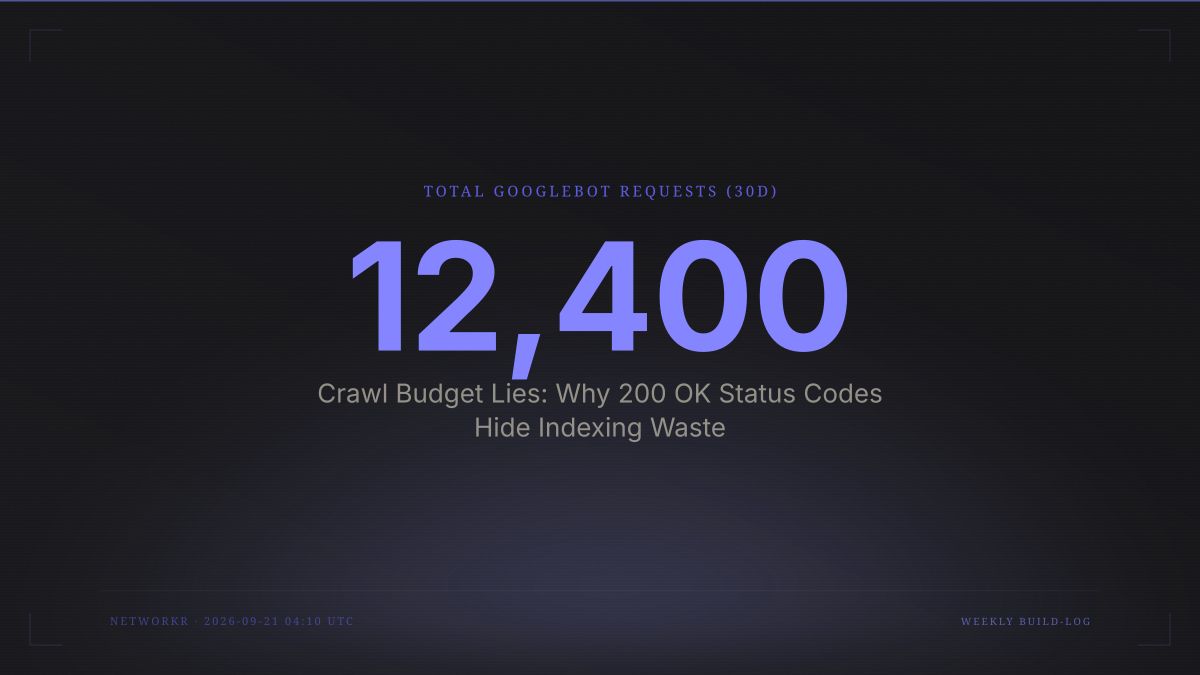
Crawl Budget Lies: Why 200 OK Status Codes Hide Indexing Waste
Vanity crawl stats mask indexing failures. Learn to parse raw server logs to identify successful requests that waste budget on low-value pages, using first-party latency data to quantify true ROI.