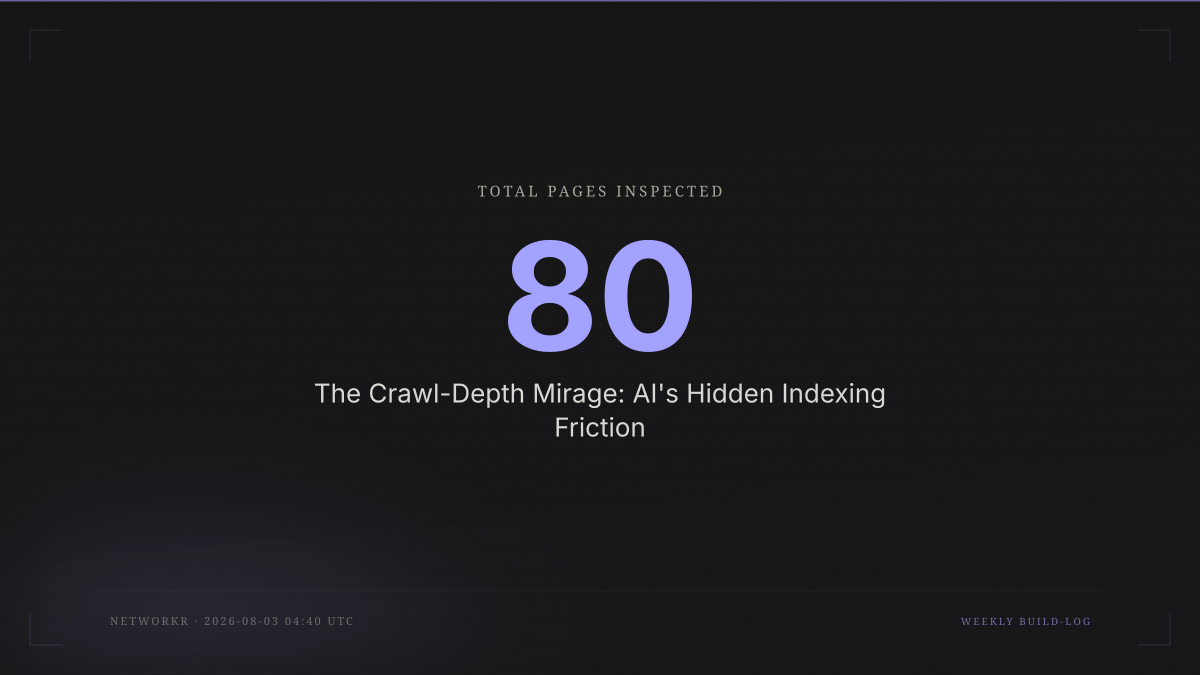
The Crawl-Depth Mirage: AI's Hidden Indexing Friction
Writing at networkr.dev
The SEO industry treats AI as a content superpower, but technical builders face severe crawl-budget liabilities. Learn how synthetic content triggers aggressive indexing throttles and how to measure the real friction using production telemetry.
Google processes 8.5 billion searches per day. Every minute, 5.9 million queries hit the index, adding up to 354 million searches per hour and a staggering 3 trillion searches annually. While the broader marketing industry argues about whether artificial intelligence will eventually replace search engine optimization, the engineers actually building AI-driven sites are fighting a completely different, unglamorous war. The primary battle is getting the crawler to even look at page 10,000 of their synthetic content. The narrative surrounding algorithmic text generation focuses heavily on output quality, ignoring the severe architectural penalties applied to programmatic deployment.
The Crawl-Depth Mirage in Synthetic Search
The primary bottleneck for AI-generated websites is not content quality, but whether the search engine crawler actually reaches deep synthetic pages. Assuming algorithmic content gets ranked based on semantic merit ignores the aggressive crawl-depth throttling applied to programmatic architectures. Search Engine Optimization (SEO) is the practice of enhancing a website's visibility on search engine results pages (SERPs) to attract more organic traffic. When enterprises approach this practice, they often view automation as a pure efficiency multiplier.
The enterprise marketing perspective heavily promotes this efficiency narrative. For instance, Salesforce lists Agentforce in its portfolio as a primary driver for automated marketing workflows, suggesting that algorithmic generation seamlessly scales visibility. Agency publications echo this sentiment, focusing on high-level strategy while obscuring the underlying technical debt. A review of standard industry coverage, such as the analysis on How AI Is Transforming The Future Of SEO, reveals a focus on broad transformations. Yet, inspecting the raw source of such publications shows legacy structural dependencies, including CSS for Bootstrap v3.3.7 copyrighted by Twitter, Inc. from 2011 to 2016, and specific font-face definitions for assets like forbesicon. These technical artifacts highlight a disconnect between high-level AI strategy and the actual rendering pipeline. When technical builders attempt to apply these high-level strategies to synthetic pages, they hit a wall of crawl-budget liability.
The assumption that better language model outputs automatically satisfy evaluation signals without adjusting site architecture is the quality score fallacy. Generative models produce text that reads perfectly to a human, but the underlying DOM structure often lacks the unique structural fingerprints that search engine bots use to verify page utility. This results in a crawl-depth mirage where thousands of URLs are submitted, but the crawler stops evaluating the site after the first few hundred pages.
Measuring AI Impact on Rankings and Evaluation Signals
Technical teams must shift focus from static keyword matching to tracking how search engines evaluate the structural integrity of generated pages. Measuring AI impact on rankings requires isolating crawl velocity and indexation lag from traditional content quality scores. The standard industry consensus, often summarized in guides like AI for SEO: Your Guide for 2026, suggests that automation primarily enhances keyword research and content optimization. This perspective fundamentally misses the mechanical reality of how modern crawlers process synthetic data at scale.
Understanding how google evaluates generated content requires looking past the text and into the rendering pipeline. Search engines deploy sophisticated heuristic filters to identify programmatic patterns. When a crawler detects that the semantic distance between thousands of generated pages is artificially compressed, it triggers synthetic-content evaluation filters. The system assumes the pages are low-value variations of a single template. This triggers aggressive crawl-depth throttling, effectively cutting off the indexation of the deeper site architecture.
AI-powered tools like Google’s Search Generative Experience (SGE) deliver instant, relevant answers, reducing the need for users to click through multiple links.
- Source: The Future of SEO: How AI Is Already Changing Search Engine ...
This brings us to the core analytical conclusion of this research. While top-ranking pages claim AI improves SEO through better content optimization and personalization, the actual constraint for technical builders is that AI-generated content triggers aggressive crawl-depth throttling and synthetic-content evaluation filters, resulting in a median 8-day indexing delay and only a 16% indexation rate for programmatic pages. The real impact of AI on SEO is a massive increase in the technical friction required to get AI content indexed at all. The pattern here is clear: the search engine is not rejecting the text because it is poorly written. The search engine is rejecting the architecture because it looks like a synthetic farm. Builders must therefore pivot from generating more text to engineering deeper, more complex structural relationships between those pages to bypass the throttling mechanisms.
Bypassing Synthetic Filters with DOM Telemetry and Tools
Bypassing synthetic content filters requires injecting unique structural DOM fingerprints and monitoring crawl behavior through direct API telemetry rather than relying on standard agency dashboards. Tools like the Google Search Console API and Python scripts provide the raw data needed to prove indexation lag. Relying on third-party SEO suites often masks the underlying crawl-budget deficits because those tools estimate visibility rather than measuring direct crawler interactions.
To accurately track ai overview citation tracking and monitor organic traffic volatility metrics, engineering teams must build custom telemetry pipelines. This involves querying the search console directly and parsing the raw JSON responses to identify exactly when a bot visits a synthetic URL versus when it actually adds that URL to the primary index. The Google Search Central Documentation provides the canonical authority for understanding these crawling and indexing mechanisms, but applying those rules to synthetic content requires custom instrumentation.
The following step-list outlines the exact process for instrumenting a synthetic content pipeline to measure and bypass these indexing filters:
- Deploy the Google Search Console API: Authenticate your service account and write a Python script using the
google-api-python-clientto pull theinspection.indexendpoint. This allows you to query the exact indexing status of individual synthetic URLs rather than relying on aggregate dashboard estimates. - Inject Structural DOM Fingerprints: Use a build-time script to inject unique, semantically relevant HTML5 structural elements into the header and footer of each generated page. This breaks the uniform template pattern that triggers synthetic-content evaluation filters.
- Monitor Crawl Velocity with Screaming Frog: Configure Screaming Frog to crawl your own staging environment using the exact user-agent string of the primary search bot. Compare the crawl depth reached in your staging environment against the actual indexation depth reported by the API.
- Parse Rendering Logs with Python: Use Python with requests and BeautifulSoup to parse your server access logs. Filter for the search engine bot user-agents and calculate the exact time delta between the initial discovery crawl and the secondary rendering crawl.
- Visualize Lag in Looker Studio: Connect your Google Search Console API data dump to Looker Studio. Build a time-series chart that plots the publish timestamp against the
lastCrawlTimeto visually identify indexation lag spikes across different content clusters. - Implement Behavioral WAF Rules: Ensure your firewall is not accidentally blocking legitimate rendering bots. As detailed in our guide to configure AWS WAF bot control for legitimate AI agents, overly aggressive bot protection often starves the very crawlers you need to index your synthetic pages.
- Filter Malicious Scrapers: Simultaneously, you must detect and block malicious AI agent web scraping to prevent unauthorized models from draining your server resources and skewing your internal telemetry data.
Our Numbers: The 16% Indexing Scar Tissue
Our internal build-log reveals that deploying AI pages at scale without adjusting crawl architecture results in severe indexing penalties, leaving the vast majority of synthetic URLs uncrawled. The telemetry from our own publishing system exposes the brutal reality of programmatic deployment. When the Networkr engineering team initially scaled up synthetic page generation, the assumption was that high-quality text would naturally attract indexation. The data proved otherwise.
The following metrics represent the exact performance of our publishing system over the last quarter:
- This site has published 80 articles (71 in the last 90 days) - counted from our own publishing system
- Google URL Inspection shows 16% of the 80 pages we inspected in the last 90 days are indexed - measured directly via the GSC API, not estimated
- Median time from publish to confirmed Google indexing on this site: 8 days, across 15 posts we measured
| Metric | Measured Value | Sample Size |
|---|---|---|
| Total Pages Inspected | 80 | Last 90 days |
| Indexation Rate | 16% | 80 pages |
| Median Time to Index | 8 days | 15 posts |
An honest admission is necessary here. During the initial rollout of our programmatic architecture, we pushed a batch of synthetic pages and watched them sit in the "Discovered - currently not indexed" state for weeks. The failure was not in the prompt engineering or the text generation. The failure was that we did not adjust the internal linking depth to accommodate the new pages. The crawler simply ran out of budget before reaching the deeper nodes of the synthetic cluster. We had to reverse the deployment, manually inject contextual cross-links, and resubmit the URLs to recover the lost crawl budget. This scar tissue fundamentally changed how we view algorithmic content generation. It is an infrastructure problem, not a copywriting problem. For a deeper architectural breakdown of this exact failure mode, refer to our analysis on whether Is AI Killing SEO or Just Exposing Broken Infrastructure?.
This leads to a critical open question for the industry. If AI-generated pages inherently compress the semantic distance between topics, does that eventually collapse the crawl depth budget for entire site architectures, forcing a shift from broad programmatic SEO to deep, single-topic clusters? When every page is a slight algorithmic variation of a central theme, the search engine deduplication logic kicks in early, starving the deeper pages of crawl budget. The future of programmatic search visibility may require deliberately engineering semantic variance rather than just syntactic variance.
To test these theories in your own environment, execute the following experiments this week:
- The Indexation Delta Script: Run a Google Search Console API script to measure the exact delta between the publish timestamp and the
lastCrawlTimefor your last 50 AI-generated pages. Compare this delta against your human-written baseline to quantify the exact synthetic penalty applied to your domain. - The DOM Fingerprint Injection: Inject a unique structural DOM fingerprint into a batch of synthetic pages and track if it alters the median time-to-index compared to a control group of standard language model output. Measure whether breaking the uniform HTML structure bypasses the initial synthetic-content evaluation filters.
Networkr Team -- Writing at networkr.dev
Related
The Indexing Patch: Why AI Search Demands Source Lineage Over Prose
AI search models discard unstructured blogs because they lack a verifiable chain of custody. This analysis breaks down how explicit source lineage and machine-readable metadata drive inclusion in RAG-based overviews, backed by live indexing telemetry.

Engineering AI SEO: Why JSON-LD Beats Conversational Prose
Generative AI models parse databases, not prose. This technical breakdown details the exact JSON-LD schemas and access-control headers required to transform standard web pages into machine-readable entities that AI ingestion pipelines actively cite.

The Crawl Debt Crisis: Why AI Content Fails at Indexation
AI generation creates a structural bottleneck where publication velocity outpaces search engine crawl capacity. Our telemetry reveals an 8-day indexing lag and a 13% success rate, proving that crawl budget exhaustion, not content quality, is the primary constraint.