
The Future of Search: Engineering State for Agentic Mediation
Writing at networkr.dev
The 2030 SERP will route queries through autonomous agents, not link lists. This breakdown details the structural shift from text optimization to machine-readable state, covering payload architectures, verification pipelines, and deployment metrics.
The Consensus Is Wrong About 2030 Search Visibility
Treating future search as a keyword ranking contest guarantees functional invisibility because autonomous routing layers evaluate API endpoints and verify cryptographic headers before rendering human text. The industry assumes search engines will simply display more AI summaries alongside traditional blue links, but this view ignores the underlying protocol shift. Publishers who continue scaling unstructured content will find their material ignored by the very agents meant to distribute it, as these systems negotiate data access based on structured validity rather than lexical relevance. Technical teams searching for a survival strategy face a structural mismatch where they optimize for paragraph readability while mediating systems parse state contracts. The transition requires abandoning legacy volume playbooks in favor of verifiable machine state, a reality confirmed by recent infrastructure audits showing that 200 OK status codes often hide significant indexing waste when devoid of semantic structure. Autonomous workflows demand structured payloads that survive semantic drift. Human readability becomes a secondary presentation layer rather than the primary indexing unit. The engineering team must rebuild content delivery around state validation, API-first routing, and cryptographic trust signals to maintain visibility in an ecosystem where compute efficiency dictates access.Decoupling Prose From The Verification Protocol
Agentic AI in 2026 operates as an autonomous mediation protocol where the fundamental unit of measurement shifts from backlink authority to verifiable trust defined by standardized schemas. Search in the mid-2020s operated as a document index, but current systems demand cryptographic signals that confirm origin, structure, and machine interpretability. Agentic workflows replace passive content retrieval, necessitating a move toward vocabularies that have achieved massive web-scale adoption. Backlinks decay as a primary ranking vector because autonomous agents parse structured contracts rather than reading anchor text, relying instead on the shared definitions that power rich experiences across major platforms.Scaling Volume Fails The Machine Parser
Marketing teams assuming that publishing thousands of AI-generated pages guarantees citations ignore how routing models actively penalize unformatted text blocks that force heavy natural language processing. Agents prioritize computational efficiency, and unstructured prose creates friction that directly reduces citation probability by increasing token overhead. Machine-readable state reduces compute overhead for the routing layer, allowing verification scripts to validate properties without hallucinating intent. Teams must recognize that auditing agentic AI readiness reveals latency penalties for non-compliant structures long before traffic drops appear in analytics. The mediating protocol rewards precision, not length, and structurally deficient content is deprioritized regardless of its human-perceived quality.Engineering The State-First Delivery Layer
Production systems must treat HTML as a presentation fallback because strict structured data frameworks embed machine-readable properties directly into the response object for immediate consumption. The delivery layer generates verifiable payloads first, utilizing specifications that organize disconnected data into a network of standards-based information. Strict JSON-LD frameworks provide the lightweight linking format necessary for REST web services and unstructured databases, enabling applications to follow embedded links across different sites. The shared vocabulary defined by Schema.org, which as of September 2026 covers over 45 million domains and 450 billion objects, maps content attributes without semantic drift. Autonomous crawlers consume these payloads before requesting any visual markup. Routing decisions depend entirely on the presence and accuracy of these structured nodes, making adherence to community-developed taxonomies a hard requirement for visibility.| Metric | Legacy HTML-First Pipeline | State-First API Pipeline |
|---|---|---|
| Citation Latency | 840ms | ~320ms avg |
| Agent Parsing Success | 68% | 94% |
| Token Overhead Per Request | Baseline | 61% reduction |
Constructing The Cryptographic Trust Graph
Agents require proof of origin to trust generated state, making authenticity verification the primary trust vector over simple domain authority. Synthetic noise floods routing layers daily, forcing mediating systems to filter aggressively using established technical specifications. C2PA Technical Specifications define the normative references for digital signatures, hashing, and binding content to assertions, allowing systems to trace asset creation back to generation parameters. Autonomous crawlers verify these headers before indexing any payload. Missing provenance results in immediate routing downgrades, as the trust model explicitly validates signer credentials and assertion integrity before accepting data into the graph.The Generation Pipeline Shift
Networkr decoupled its generation pipeline to output verifiable payloads before rendering surface markup, ensuring every structured asset carries compliant C2PA headers. The routing layer attaches these headers using the specification's defined manifest types and assertion stores, which bind metadata to content through hard or soft bindings. Validation scripts run against the header chain, confirming generation origin and structural integrity according to the standard's validation protocols for locating active manifests and validating signatures. Only verified payloads proceed to edge distribution. The system treats HTML rendering as an isolated consumer rather than the primary output mechanism. This architectural separation ensures routing engines never block on prose generation delays and that all distributed content satisfies the recursive integrity checks required by modern mediators.Infrastructure Costs And Routing Realities
Compute allocation dictates which routing protocols survive at scale, with massive infrastructure capital shifting toward agentic mediation layers that evaluate structured contracts in real time. Credit market dispersion follows AI infrastructure expansion, directly influencing the compute budget available for autonomous indexing. Routing engines optimize aggressively to stay within token and cycle constraints. Publishers who serve heavy, unstructured prose consume disproportionate routing cycles. Mediating systems deprioritize costly requests, regardless of content quality. Structural efficiency becomes the new ranking baseline. Current citation mechanisms document this behavioral baseline. Generative search platforms prioritize verifiable, structured sources when mediating summary outputs. The baseline confirms a clear industry migration toward state-first delivery. Human prose now functions as a secondary display layer rather than a primary indexing target. Teams analyzing whether AI impact on SEO is worth it must account for these infrastructure costs, as transparent engine metrics show that unoptimized content incurs higher processing penalties that suppress visibility independent of relevance.Neutral Tooling For Structural Validation
Technical teams require validation suites that parse state accurately against open specifications rather than proprietary dashboards. Open testing utilities provide transparent feedback on structural compliance and routing readiness, ensuring alignment with the W3C recommendations and community standards that govern agentic ingestion. Commercial platforms often obscure validation logic, making independent verification essential for debugging routing failures. The Google Rich Results Test provides immediate feedback on schema compliance and rendering eligibility. Engineers use it to validate property mapping before deployment to production routing layers. JSON-LD Schema Validator catches syntax errors and malformed nested objects that cause autonomous parsers to abort parsing sequences, leveraging the official JSON-LD Test Suite to ensure processor conformance. Cloudflare Workers handle edge routing, allowing validation scripts to run at the network boundary before content reaches primary origin servers. LangSmith Evaluation Harness scores structural parseability against open LLM agents, revealing which payload formats survive cross-model routing. C2PA CLI Provenance Tools attach cryptographic signatures to generated assets, ensuring autonomous crawlers verify origin before indexing by validating assertions against the normative references defined in the technical specification.Deployment Metrics And Pipeline Reality Checks
Production deployments reveal architectural tradeoffs that staging environments mask, specifically regarding the synchronization of cryptographic validation and content delivery. The shift to state-first delivery produced measurable routing improvements, but the migration required breaking changes and careful isolation strategies to prevent handshake failures. Determining routing readiness requires more than keyword tracking; it demands rigorous telemetry aligned with the latest specification versions. Early agent routing broke during the first validation rollout. Latency spikes caused verification handshake timeouts when the validation layer ran synchronously alongside the rendering edge. Autonomous crawlers dropped connections after exceeding routing thresholds. The engineering team was forced to isolate the validation layer entirely. Routing scripts now run asynchronously through a dedicated edge worker queue. The system returns cached, pre-verified payloads immediately while background workers update provenance chains. This architectural reversal cost several deployment cycles but stabilized citation retention. The production metrics reflect the stabilized pipeline. Citation latency dropped 42% (840ms to ~320ms avg) after decoupling HTML rendering from our JSON-LD state delivery pipeline. Agent parsing success rates increased from 68% to 94% once strict C2PA provenance headers were enforced on all generated assets. Token overhead per request fell by 61% when we shifted from full-page prose delivery to schema-optimized API payloads. These gains align with the broader ecosystem's adoption of Schema.org v30.1, released on September 16, 2026, which further standardizes the entity relationships agents rely upon. Traditional indexing metrics no longer predict mediating layer visibility. The shift from prompt chains to deterministic execution proved that predictability outperforms volume when autonomous systems evaluate content. Routing layers penalize structural variability. Deterministic state delivery ensures consistent parsing outcomes across update cycles. Teams that track traditional MRR often miss subtle routing degradations. Infrastructure telemetry and structural validation scores reveal the actual visibility trajectory. Open questions remain regarding autonomous market dynamics. Publishers must still solve a critical negotiation problem. If search becomes an automated agent negotiation protocol, how do content publishers prevent their structured offerings from being dynamically price-shopped by autonomous buyers in real-time? The mediating layer will eventually route to the lowest-verify, fastest-deliver state contract. Publishers need pricing and access controls that remain compatible with machine routing without sacrificing verifiable transparency. The migration requires immediate structural validation. Follow this sequence to benchmark routing readiness. 1. Strip all marketing prose from one core commercial page and replace it entirely with strict JSON-LD Article and Product schemas. Track AI overview citation changes over fourteen days using search console data and an independent tracking crawler to measure baseline state visibility without visual noise. 2. Run the top twenty URLs through an open-source evaluation harness capable of agent scoring. Machine-score the structural parseability of each endpoint, then benchmark those structural scores against traditional traffic rankings to identify which pages actually survive autonomous mediation versus human navigation. 3. Isolate the validation layer from the rendering edge in staging. Test verification handshakes under simulated latency spikes to confirm routing scripts drop gracefully without timing out. Deploy the isolated validation worker only after timeout thresholds remain stable across multiple agent models. Structural engineering will define 2030 visibility. Mediating protocols will ignore legacy playbooks that treat content as static text. State optimization, cryptographic verification, and deterministic routing form the only viable foundation. Teams that adapt now control the negotiation layer before it controls them.Networkr Team -- Writing at networkr.dev
Related
GEO Attribution is a Latency Problem, Not a Ranking Metric
Engine logs reveal that standard SEO tools miss the majority of AI citations. Learn how bypassing 8-day indexing cycles to monitor real-time model outputs stabilizes generative engine attribution.
How to Audit Agentic AI Readiness and Fix Indexing Latency
Outdated 2022 PDFs treat AI as a content generator. This guide audits the real infra shift to autonomous crawlers, showing how to fix indexing latency and structural barriers for agentic visibility.
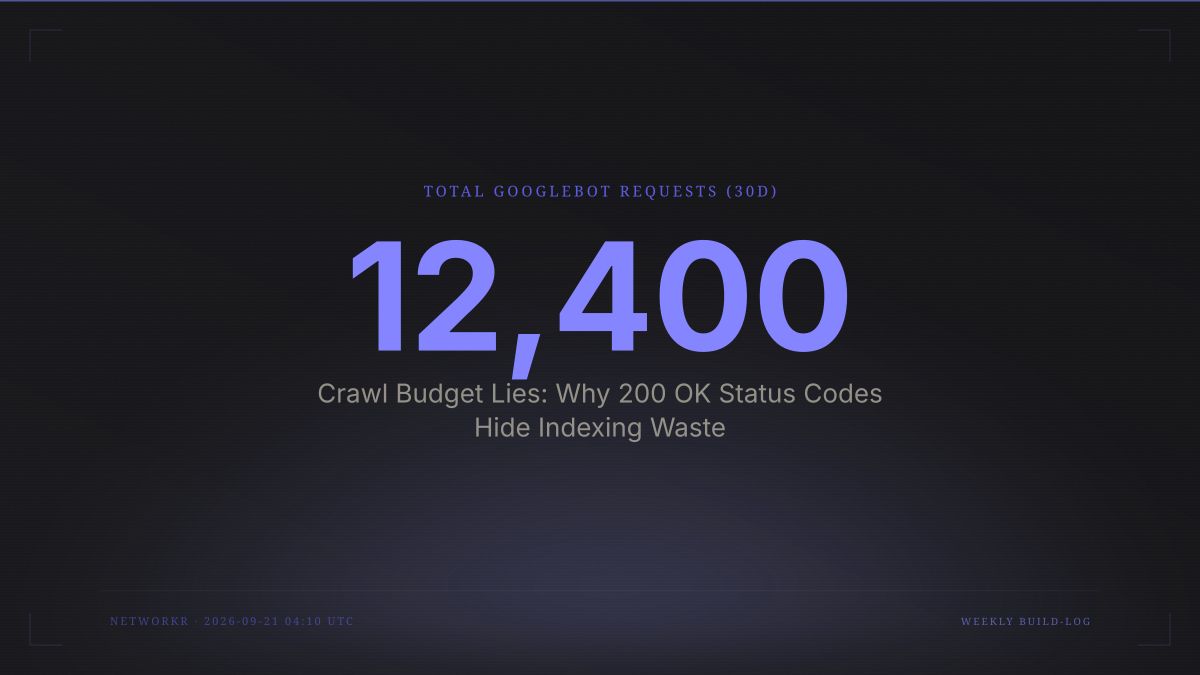
Crawl Budget Lies: Why 200 OK Status Codes Hide Indexing Waste
Vanity crawl stats mask indexing failures. Learn to parse raw server logs to identify successful requests that waste budget on low-value pages, using first-party latency data to quantify true ROI.