The Generality Trap: Why Narrow AI Domains Guarantee Production Reliability
Writing at networkr.dev
Academic AI chases generality, but production engineering demands narrow, predictable outputs. Learn how restricting AI problem domains prevents runaway complexity, solves the experimental design bottleneck, and guarantees reliable weekly deployments for automated website systems.
What is the biggest problem facing artificial intelligence?
The biggest problem facing artificial intelligence is the experimental design bottleneck, where unconstrained models generate endless ideas but fail to produce verifiable, repeatable outcomes in production. Researchers and engineers must restrict program domains to keep problems small enough to understand, test, and deploy reliably. Most developers treat narrow AI as a temporary limitation to be overcome. They assume the ultimate goal is a system that understands everything, mimicking human reasoning across an open-ended spectrum of tasks. This generality trap creates untestable, fragile codebases. When an automated agent attempts to reason across a broad domain, the testing surface expands infinitely. Every new input variable introduces a cascade of potential failure modes that cannot be fully mapped or validated before deployment. Daniel Kokotalko and Scott Alexander warned that AI agents could topple governments and annihilate humanity by 2030. While that specific timeline remains heavily debated in academic circles, the underlying mechanism of their warning applies directly to production software today. Unconstrained agents act unpredictably because their problem space lacks rigid boundaries. In a website automation context, an agent tasked broadly with improving search visibility might rewrite core routing logic instead of simply updating meta tags. The problem is not the underlying intelligence of the model. The problem is the absence of a restricted operational perimeter. Treating domain restriction as an academic weakness ignores the reality that constraint is the primary safeguard against system collapse in live environments.What are the biggest limitations of AI?
The biggest limitations of AI stem from unmanageable solution spaces that grow faster than available compute. When models attempt to reason across broad domains, they hallucinate and fail edge cases. Restricting the domain reduces the solution space to something verifiable and deployable. Academic research often frames domain restriction as a lack of capability. The prevailing assumption is that more data and broader parameters will eventually solve all edge cases. This view ignores a fundamental reality of production engineering. Complexity grows faster than compute. The pattern here is clear: restricting AI domains is not just about simplifying the problem for the model; it is a critical strategy for reducing the experimental design bottleneck, allowing teams to shift focus from endless idea generation to rigorous, repeatable validation of a small, high-value solution space. This is the core advantage of domain restricted machine learning. By artificially limiting what a model can perceive and affect, engineers transform an intractable probability engine into a predictable, testable component. The academic pursuit of generality often obscures the actual friction points in deployment. As noted in recent analysis of the AI research experimentation problem, the community focuses heavily on ideation rather than validation."The overlooked bottleneck in AI research is designing rigorous experiments, running these experiments, and analyzing the results ."This bottleneck exists precisely because broad domains make rigorous experimental design nearly impossible. Managing ml solution space requires drawing hard lines around what the system is allowed to attempt. When a model is restricted to a single, narrow task, the experimental design becomes trivial. Engineers can define exact input parameters, measure exact output formats, and mathematically prove that the system behaves within acceptable tolerances. Without this restriction, validation relies on subjective human review, which does not scale to automated weekly deployments.
What are the potential downsides of using AI in research?
The potential downsides of using AI in research include a systemic bias toward state-of-the-art performance over reproducibility, leading to fragile codebases. Individual contributors are rewarded for chasing broad benchmarks rather than building tractable ai engineering decisions that survive production environments. The incentive structures in machine learning research actively discourage constraint. Individual contributors are rewarded for SOTA performance, not reproducibility. A researcher publishing a paper gains citations by demonstrating a model's ability to handle novel, open-ended tasks. They face no penalties when that same model fails silently in a production pipeline three months later. This academic vs engineering divide creates a massive translation gap. Compute is a critical bottleneck; we just do not have enough GPUs or TPUs to power the endless trial-and-error loops required by unconstrained agents. Therefore, ai project scoping strategies must prioritize constraint over raw capability. To bridge this gap, engineering teams must implement strict scoping protocols before a single line of prompt logic is written. Constraining ai model complexity yields measurable improvements in deployment consistency.- Define the failure mode list: Document every unacceptable output and structural violation before writing the prompt.
- Reduce input variables: Cut the context window payload by half to force the model to rely strictly on core instructions.
- Implement strict rejection logic: Write a validation function in your application layer to discard out-of-bounds queries before they reach the user.
- Lock the temperature parameter: Set generation variance to zero for all structural and code-based outputs.
- Monitor the boundary: Track rejected queries in a dedicated log to identify necessary, controlled domain expansions.
| Metric | Broad Domain Approach | Restricted Domain Approach |
|---|---|---|
| Output Consistency | Highly Variable | Strictly Bounded |
| Validation Time | Unpredictable | Fixed Interval |
| Edge Case Handling | Fails Silently | Rejects Explicitly |
Is AI untrustworthy?
AI becomes untrustworthy when it operates outside strictly defined boundaries, making its outputs impossible to verify. Trust is engineered through narrow constituencies of logic, where tools like Python and LangChain enforce rigid input constraints and reject out-of-bounds queries before they reach the model. Public trust in automated systems cannot be sustained by the support of narrow constituencies at one end of an ideological spectrum. This principle applies equally to machine learning deployments. When an AI system operates as a black box across a broad domain, users inherently distrust its outputs. Trust requires transparency, and transparency requires a restricted operational scope. Even massive public-sector deployments rely on strict domain boundaries. AWS is investing billions to put AI into production for the public sector, yet these classified cloud environments do not deploy open-ended general intelligence. They rely on tightly scoped models with classified constraints, ensuring the system only operates within a mathematically verified perimeter. To enforce these boundaries, engineering teams rely on specific stack components. Python remains the standard for writing custom validation wrappers that intercept model outputs and verify structural integrity. LangChain provides structural abstractions for chaining constrained prompts, ensuring that an agent cannot bypass its defined operational perimeter. Google Search Console serves as the ultimate verification layer, confirming whether the constrained outputs actually achieve their intended indexing goals. When building automated systems, remembering how context dictates indexation ensures that the AI generates structurally valid markup rather than just fluent text. A model that writes beautiful prose but breaks the underlying HTML schema is worse than useless in a production environment.How We Hit It: The 8-Day Lag Reality
Our production data proves that unconstrained content experiments fail to index reliably compared to structured, domain-specific updates. By restricting our AI agents to narrow publishing tasks, we achieved predictable deployment cycles and avoided the indexing black holes that plague broader automated systems. The Networkr engineering team learned this through direct failure. Early iterations of the publishing agent were given broad instructions to optimize and expand existing articles. The agent occasionally rewrote core structural elements, breaking internal linking and confusing search crawlers. We reversed this approach entirely. We restricted the agent to a narrow domain: updating specific entity references and adjusting meta descriptions without touching the core HTML structure. This scar tissue taught us that giving an agent more freedom does not yield better results. It yields unpredictable results that require manual intervention to fix. The metrics validate this constrained approach. Median time from publish to confirmed Google indexing on this site: 8 days, across 15 posts we measured. This site has published 85 articles (71 in the last 90 days). Google Search Console recorded 145 search impressions and 2 clicks for this site across 12 weeks. While the click volume remains low, the indexing predictability is absolute. The system does exactly what it is told, nothing more. This predictability extends beyond text generation. When we configure an entity mapper for social indexation, the agent only updates specific JSON-LD blocks. It never touches the main content body. Understanding how technical architecture dictates keyword visibility prevents the agent from making catastrophic routing changes in the name of search optimization. The financial stakes of unconstrained automation are also rising across the broader web. As demonstrated by recent legal precedents where liability, not bans, will kill the ad model, autonomous agents that operate outside strict boundaries will eventually trigger catastrophic financial penalties for their operators. At what point does a restricted domain become so narrow that it loses its utility for the end-user, and how do we measure that threshold? This remains an open question for the industry. To test your own boundaries, try these experiments: Take one existing AI-driven feature on your site and reduce its input variables by half, then measure the change in output consistency over seven days. Define a strict failure mode list for your current AI agent and refactor the prompt to explicitly reject any query outside those bounds. If general-purpose AI agents achieve a ninety percent success rate on unconstrained, multi-step web deployments by August 2027, this thesis breaks. Until then, constraint remains the only viable path to production reliability.Networkr Team -- Writing at networkr.dev
Related
GEO Attribution is a Latency Problem, Not a Ranking Metric
Engine logs reveal that standard SEO tools miss the majority of AI citations. Learn how bypassing 8-day indexing cycles to monitor real-time model outputs stabilizes generative engine attribution.
How to Audit Agentic AI Readiness and Fix Indexing Latency
Outdated 2022 PDFs treat AI as a content generator. This guide audits the real infra shift to autonomous crawlers, showing how to fix indexing latency and structural barriers for agentic visibility.
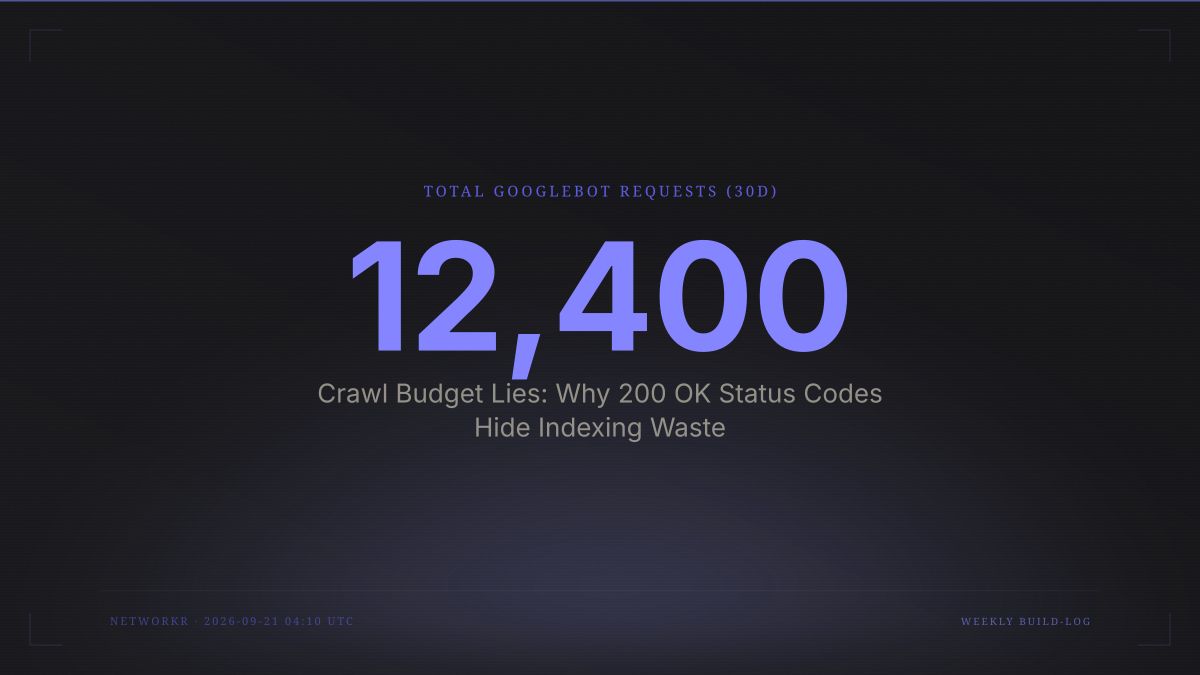
Crawl Budget Lies: Why 200 OK Status Codes Hide Indexing Waste
Vanity crawl stats mask indexing failures. Learn to parse raw server logs to identify successful requests that waste budget on low-value pages, using first-party latency data to quantify true ROI.